


The Self-Sabotage Cycle: Why You Keep Holding Yourself Back (And How to Reset in 30 Days)
- Mary Nyokabi
- Sep 21, 2025
- 4 min read


The highest form of self-sabotage isn’t procrastination, laziness, or lack of discipline. It’s when your fear of failing yourself is so heavy that you reject yourself before anyone else ever gets the chance.
It looks like not sending that email that could change your life because the sting of a “no” feels unbearable. It looks like never starting the book you’ve dreamed of writing because you fear nobody will read it. It looks like shrinking right at the edge of opportunity because the thought of losing it feels more terrifying than never having it at all.
If this feels uncomfortably familiar, you’re not alone. Self-sabotage is one of the most common — and least talked about — ways low self-worth shows up. Let’s explore why it happens and how you can finally break free with a guided 30-day reset.
What Self-Sabotage Really Looks Like
Self-sabotage is rarely obvious. It doesn’t usually announce itself as “I’m holding myself back.” Instead, it hides under the mask of caution, perfectionism, or “waiting for the right time.”
Everyday Examples of Self-Sabotage
Not sending an application or email because rejection feels unbearable.
Procrastinating on a dream project until it becomes a fantasy.
Ghosting opportunities or relationships right as they’re about to deepen.
Overpreparing, overthinking, or convincing yourself you need to be “ready first.”
If you’ve ever wondered why you can’t seem to follow through — even on things you want — you’ve likely brushed up against self-sabotage.
Why We Do It: The Root Causes of Self-Sabotage

Behind self-sabotage isn’t laziness. It’s fear, unhealed self-worth, and unconscious conditioning that make shrinking feel safer than succeeding.
The Psychological Trap: When Your Mind Links Success With Pain
Our brains are incredible at keeping us safe, but sometimes that “safety” comes at the cost of growth. If you’ve ever been rejected, abandoned, or harshly criticized after trying something new, your nervous system stores that memory like a scar. It whispers: “Success is dangerous. Trying is risky. Staying small keeps me safe.”
This is why you may find yourself hesitating right before big opportunities — because your subconscious has tied success and visibility to pain. It’s not that you don’t want to grow; it’s that an old part of you still believes growth will cost you love, acceptance, or belonging.
The Spiritual Block: When Your Energy Closes Off Receiving
Beyond the mind, there’s an energetic layer to self-sabotage. Low self-worth vibrates at the frequency of fear, doubt, and “not enoughness.” This vibration acts like static, interfering with your ability to receive abundance, love, or opportunities with openness.
On a soul level, when you don’t feel safe in your worth, your energy contracts. You shrink, you deflect compliments, you dismiss opportunities — not because you don’t want them, but because deep down, they don’t feel safe to hold. Success becomes overwhelming because your vibration is tuned to survival, not expansion.
The Practical Cycle: Habits That Keep You Playing Small
Finally, sabotage thrives in the everyday actions (or inactions) that quietly reinforce your fears. Maybe you avoid starting a project by scrolling endlessly. Maybe you convince yourself you’re “too busy” to write, create, or apply. Maybe perfectionism keeps you polishing an idea forever, instead of letting it breathe into the world.
These habits form a self-fulfilling cycle: avoidance protects you from risk in the short term, but robs you of growth in the long term. Without daily rituals that anchor self-worth and intentional action, the cycle repeats — because your default behaviors will always pull you back into the familiar pattern of staying small.
The Hidden Truth: It’s Not Laziness — It’s Fear of Losing What You Gain

When your worth feels conditional, success feels dangerous. The higher you rise, the more you fear the fall. Subconsciously, sabotaging feels safer than achieving because you can’t lose what you never gained.
This is why self-sabotage isn’t just about “working harder” or “pushing through.” It’s about healing the relationship you have with yourself.
How to Break the Cycle of Self-Sabotage
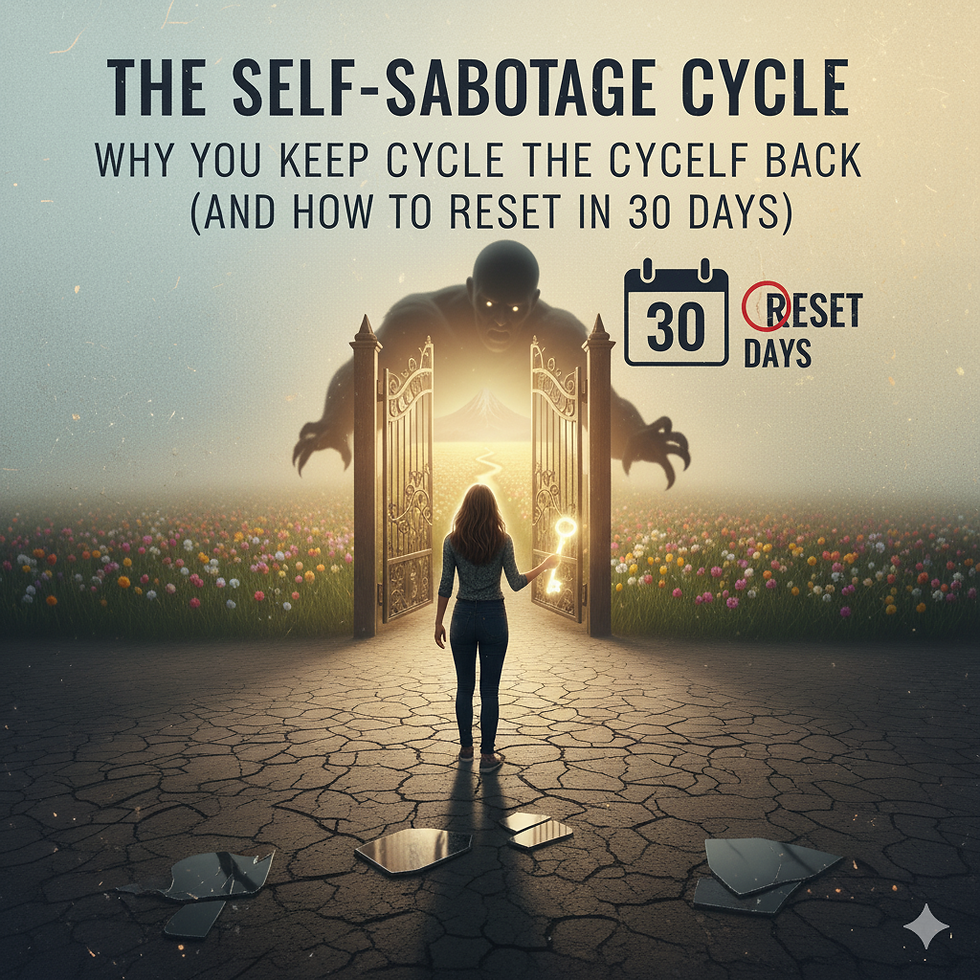
The antidote isn’t more hustle — it’s practicing the truth that your worth is inherent. When you know you are enough, success and failure lose their power to define you.
Step 1: Create Awareness Through Reflection
Name the beliefs that drive your sabotage. Ask yourself:
Do I quit when things get good?
Do I fear rejection more than I crave success?
Where did these beliefs start?
Awareness is the first step to breaking the pattern.
Step 2: Reprogram Your Beliefs With Affirmations
Affirmations aren’t magic words — they’re tools for rewiring the subconscious. The key is daily repetition, tied to emotion. Try:
“My worth is not defined by outcomes.”
“It’s safe for me to succeed.”
“I am already enough.”
Step 3: Build Daily Self-Love Habits
Your self-worth grows stronger when nurtured daily. Simple practices like journaling, mood check-ins, or celebrating small wins remind you that you matter — with or without achievements.
Why a 30-Day Reset Works
Change doesn’t happen from one big breakthrough. It happens from repeated, daily choices that shift your energy, beliefs, and habits. A 30-day reset gives you:
Reflection prompts to uncover limiting beliefs.
Daily journaling to connect with yourself.
Affirmations to rewire your subconscious.
It’s not about doing more. It’s about practicing self-worth until it becomes your new normal.
Introducing the Self-Worth Reset Bundle

That’s why I created the Self-Worth Reset Bundle — a complete 30-day system designed to move you out of sabotage and into self-trust.
Here’s what’s inside:
Self-Worth Reflection Workbook → uncover and reframe limiting beliefs.
14-Day Self-Love Journal → build simple daily habits of self-connection.
30-Day Self-Empowerment Affirmation Deck → reprogram your mind with confidence, boundaries, and abundance.
Together, they create the structure your self-worth has been missing. Instead of piecing together random tips, you’ll have a guided path that anchors, nurtures, and expands your worth — day by day.
Conclusion
You don’t have to keep rejecting yourself before the world has a chance to see you. Self-sabotage isn’t your identity — it’s a pattern built from fear. And patterns can be broken.
In 30 days, you can build a new rhythm: one where self-worth is your foundation, success feels safe, and showing up fully becomes natural.
👉 Begin your 30-Day Self-Worth Reset today and step into the knowing that you were enough all along.


Comments