


The Sterling Money Mirror: Tracing Your Scarcity Story to Its Origin for Real Freedom
Updated: Aug 2

The way you respond to money today is rarely about the money itself. It is about something older, quieter, and far more invisible running in the background. This is where tracing your scarcity story becomes less of a concept and more of a confrontation with how your financial reality was quietly designed.
You can earn more, plan better, and still feel like something is off. Not because you lack discipline, but because your internal money mirror is reflecting a version of reality built from childhood observations, emotional impressions, and inherited beliefs.
Until that mirror is seen clearly, every financial strategy feels like pushing against fog.
There is a reason certain financial wins do not feel like wins. And a reason certain expenses feel heavier than they should. That reason is not in your bank account. It is in the story you absorbed before you had language for it.
The Moment It Starts
It rarely starts with a dramatic event. It starts with a moment that looked ordinary at the time. A quiet tension at the dinner table when bills were mentioned. A parent changing their tone when money came up. Maybe it was a subtle shift in energy when someone talked about people who had more. Your nervous system recorded all of it before your mind could interpret it.
This is how the internal script begins, not through instruction, but through observation. You were not taught your money beliefs. You inherited them through emotional pattern recognition.
And once a belief is stored in the body like that, it does not disappear just because life changes. It waits for confirmation. It waits for repetition. It waits for you to live it out without realizing you are following a script.
The Real Problem Is not your income, it is the unseen narrative shaping every financial decision
Financial stagnation is rarely about effort or intelligence. It is the deeper layer of meaning attached to money itself. Tracing your scarcity story reveals that most financial behavior is not strategic; it is emotional memory disguised as logic.
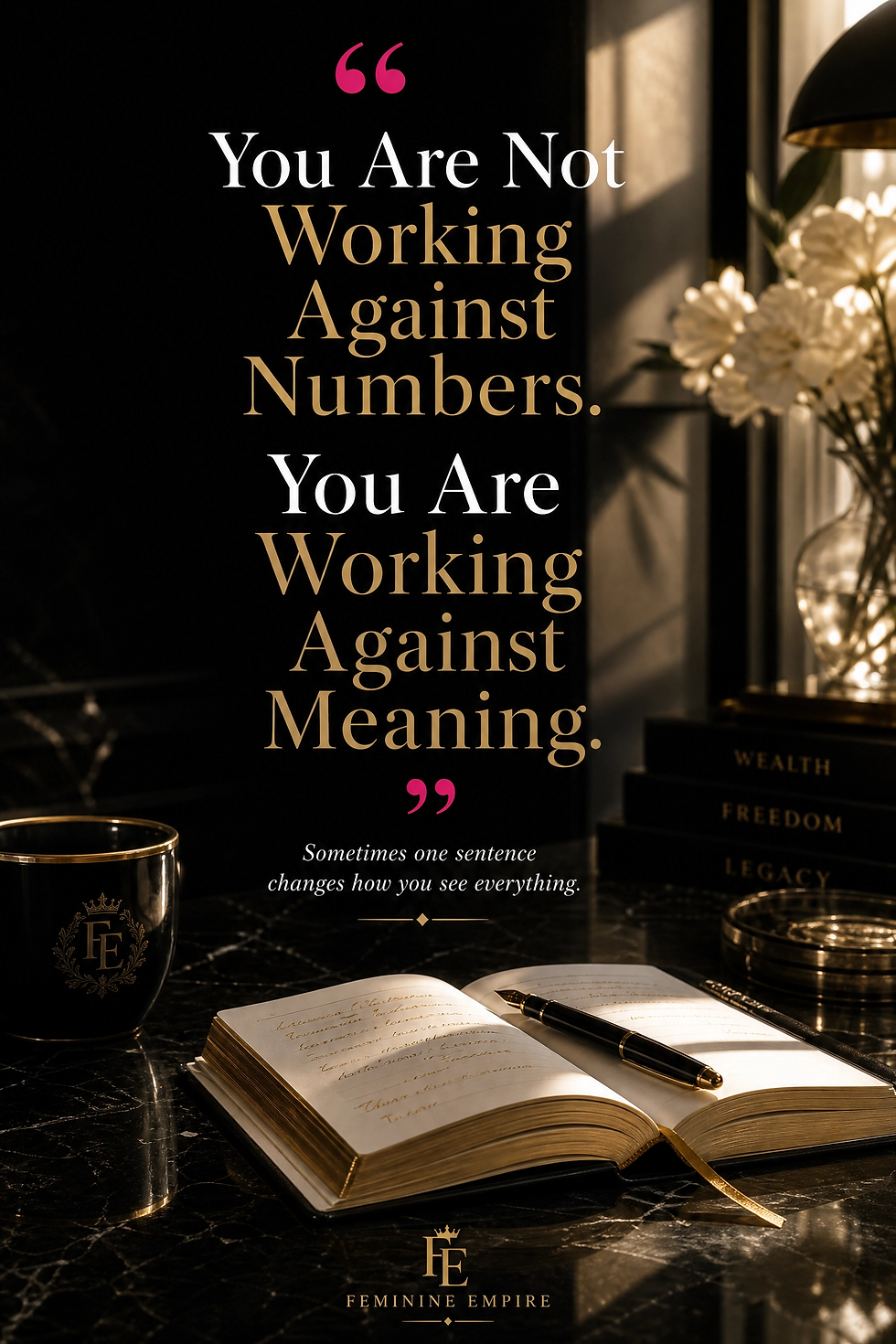
This is why people can know what to do and still not do it. It is why budgeting systems fail to stick, and why income growth does not always translate into felt security. You are not working against numbers. You are working against meaning.
In Money, But Make It Sexy, Isla Sterling describes Scarcity Stories as deeply embedded beliefs formed early in life that define what you unconsciously allow yourself to have. One of the most precise definitions in the book states: "A Scarcity Story, precisely defined, is any belief about money that limits how much of it you will allow into your life, formed in reaction to someone else's experience rather than your own."
What's Really Going On

Early emotional experiences form a baseline story about safety, worth, and money. That story then filters every financial decision you make.
You might interpret caution as responsibility and undercharging as humility. You might interpret financial anxiety as realism. Underneath all of it is a single operating system trying to keep you aligned with what it once learned about safety.
Scarcity is not just a lack of money. It is a learned relationship with uncertainty. And that relationship becomes self-reinforcing because every decision made within it strengthens its authority.
Once you see this, money stops looking like something you are bad at. It starts looking like something you have been trained to experience in a specific emotional way.
Why This Is not Your Fault
No one consciously chooses a scarcity identity. It is built quietly through repetition, environment, and emotional absorption long before you had the capacity to question it.
In most environments, money was not discussed with clarity. It was hinted at, avoided, stressed over, or associated with tension. A child does not analyze that. A child adapts to it.
As Isla Sterling writes in the same framework, "Not for people like us is the most expensive sentence in the English language."
That sentence does not arrive as a rule. It arrives as a feeling. A hesitation. A subtle belief that certain levels of ease, wealth, or expansion belong to someone else. And once that belief is in place, every opportunity is filtered through it.
Nothing about this pattern makes you broken. It makes you patterned. And patterns can be interrupted the moment they are seen clearly enough to stop being invisible.
The Hidden Pattern is a loop where old meaning keeps recreating new financial outcomes

There is a loop that forms when scarcity stories go unexamined. It is not random. It is structured. It repeats in predictable ways that feel personal but are actually patterned.
This is the point where tracing your scarcity story becomes powerful. Because once the pattern is named, it stops feeling like personality and starts revealing itself as repetition.
Signs You are Living This Loop Right Now
You delay pricing decisions even when you already know your value.
You feel uneasy when money stays in your account instead of being spent or redistributed quickly.
You justify undercharging by telling yourself you are still building credibility.
You feel emotionally safer earning just enough rather than expanding beyond what feels familiar.
You experience guilt after financial wins, as if something needs to be corrected.
You find yourself attracted to financial advice that keeps you safe but not expanding.
You describe financial stress as normal, even when it is unnecessary.
Each of these is not a flaw. It is a signal. A behavioral fingerprint of a deeper story running beneath awareness.
And once you start recognizing the loop, something important shifts. You stop identifying with the behavior and start observing it. That distance is where change begins.
What Actually Shifts Everything is not more effort, it is a different internal reference point

Real financial change does not come from pushing harder against the same internal story. It comes from changing the reference point the story is built on. This is where tracing your scarcity story becomes a turning point instead of just reflection.
When you begin to see money through the lens of inherited meaning rather than fixed truth, your decisions start to loosen. You are no longer reacting to emotional memory. You are responding to present reality.
In Money, But Make It Sexy, this shift is framed through the idea that financial behavior follows belief, not circumstance. Once belief is updated, behavior begins to reorganize itself naturally. Not instantly, but inevitably.
A New Way to Look at This
One of the most powerful realizations in this process is that you are not trying to become someone new. You are removing distortions from how you already see yourself.
A simple starting point is this. Notice where your financial reactions feel automatic. Then ask what they are protecting. Not to judge them, but to understand them.
That moment of awareness interrupts the loop. And interruption is where new behavior becomes possible.
You do not need perfect clarity to begin. You only need enough awareness to stop confusing inherited fear with personal truth.
And if that awareness feels uncomfortable at first, that is not resistance. That is recognition.
Your Next Step is to turn awareness into direct experience of a new financial lens
There is a point where understanding is no longer enough. You begin to notice the pattern, but still feel it running in real time. That is where deeper work begins, not as theory, but as practice.
This is where tools matter. Not because they fix everything, but because they give structure to what you are now able to see. Tracing your scarcity story is not just insight work. It is applied awareness.
The next step is a guided exercise that helps you locate your own money mirror, identify where it formed, and begin rewriting the internal sentence that has been quietly shaping your financial decisions.
A free preview of Money, But Make It Sexy includes two foundational exercises drawn directly from this framework. They are designed to move you from recognition into real internal recalibration, not through force, but through clarity.
The shift does not come from adding more. It comes from finally seeing what has been operating without your awareness and choosing differently from there.
You can explore the preview or buy the book on Apple Books, where the full framework continues beyond this initial work into deeper layers of financial identity and behavior.
FAQ
What is a scarcity story in money psychology?
A scarcity story is an inherited belief about money formed from early emotional experiences rather than personal truth, shaping how you unconsciously handle finances.
How do I know if I have a scarcity story?
You often feel anxious around money decisions, undercharge your value, or experience guilt after financial gains without understanding why.
Can scarcity stories actually be changed?
Yes, once identified, they can be rewritten by separating inherited beliefs from current reality and consistently acting from a new reference point.
Why does money feel emotionally charged even when I earn enough?
Because emotional memory, not income level, often determines your internal experience of safety and abundance.
Where can I buy the book?
Money, But Make It Sexy by Isla Sterling is available on Apple Books.


Comments